Look it up
être, faire, parler …
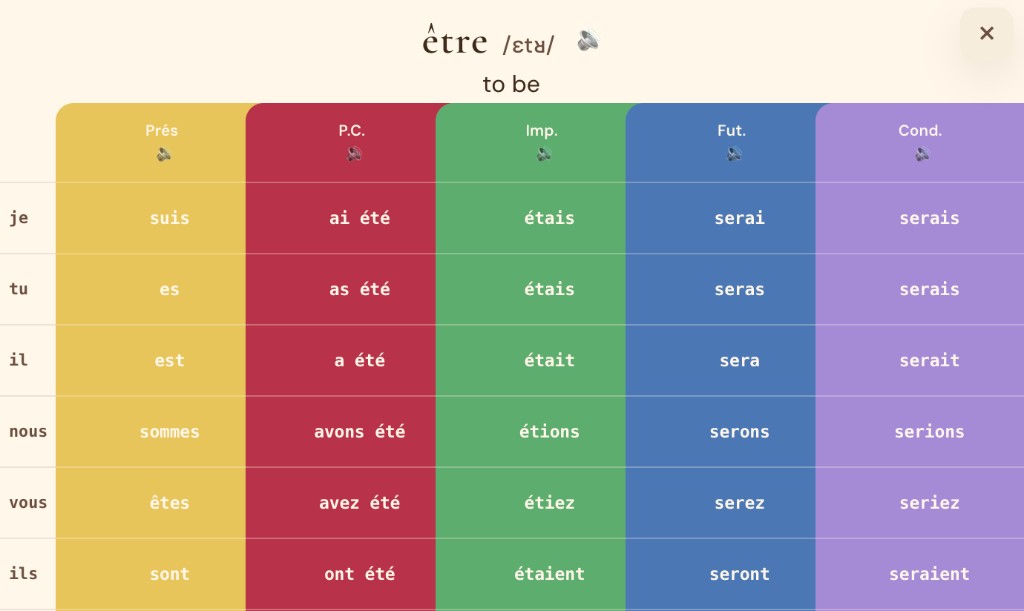
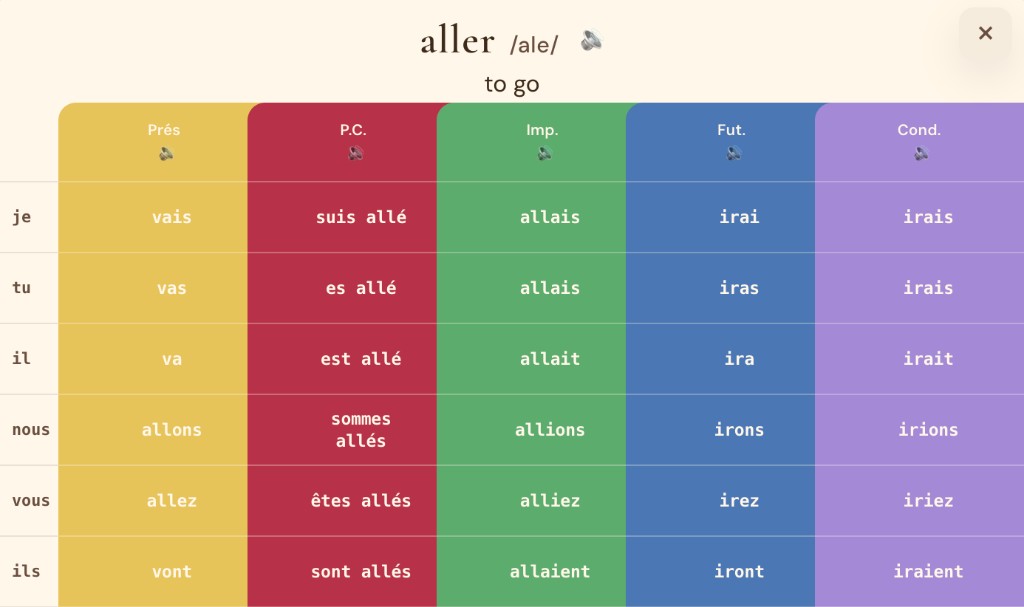
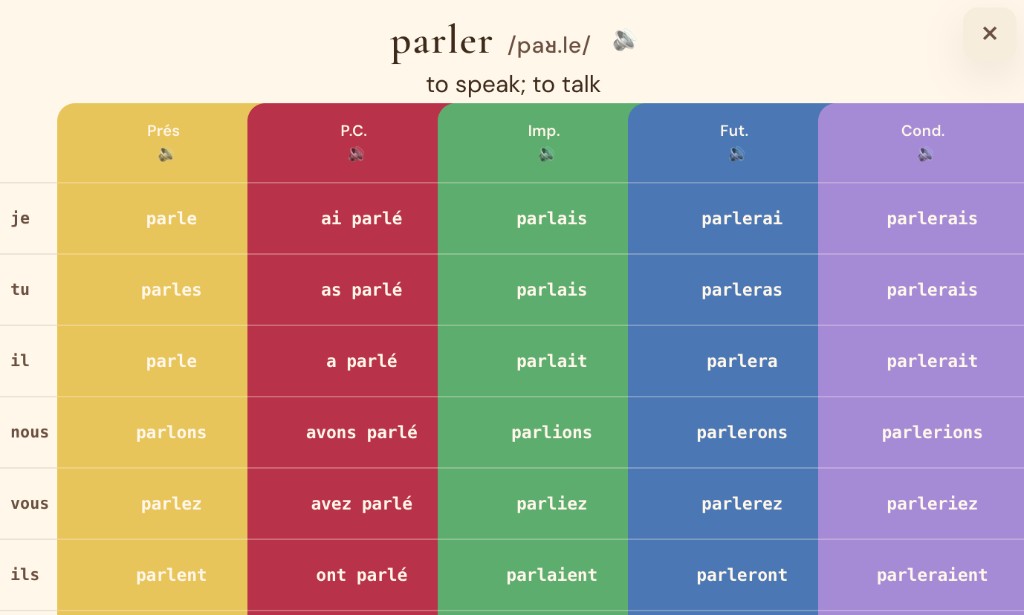
 French Bites
Launch App
French Bites
Launch App
Master the five tenses you actually need:
Color-coded to your brain.
They are also notoriously tricky to conjugate — irregular forms, stem changes, and agreement rules make them a real challenge for beginners.
To make the journey easier, we built color-coding into the heart of our design. Each tense has its own dedicated color throughout the platform.
When you repeatedly see the same color linked to the same tense, your brain naturally begins to sort and recognize them separately — rather than facing all five as one overwhelming block. A small detail that makes a big difference over time.
And there is more good news.
These five tenses are also the building blocks of the broader French tense system.
The Subjonctif Présent shares much of its conjugation with the Present.
The Plus-que-parfait follows the exact same pattern as the Passé Composé, simply using the Imparfait of the auxiliary instead.
Similarly, the Futur Antérieur and the Conditionnel Passé are direct extensions of the Futur Simple and the Conditionnel.
In other words, once you have mastered these five tenses, you will not be starting from scratch — you will already have a head start on everything that comes next.
The conjugation tool that makes you actually use what you learned.
Je à l'école à pied.
I go to school on foot.
Tu où exactement ?
Where exactly are you going?
Elle au marché le samedi.
She goes to the market on Saturdays.
Nous au cinéma ce soir.
We're going to the cinema tonight.
Vous bien ?
Are you doing well?
Ils à Paris cet été.
They're going to Paris this summer.


Why French Bites
Coming next.
Q&A
These five — présent, passé composé, imparfait, futur simple, and conditionnel présent — cover most everyday spoken and written French. Advanced forms like the subjonctif, plus-que-parfait, and passé simple build on the same stems and patterns, so mastering these five first gives you a usable core without learning the full tense system at once.
Learn them in this order: présent → passé composé → imparfait → futur simple → conditionnel présent.
Présent teaches the main conjugation patterns; passé composé is the default spoken past; imparfait comes next so you can contrast completed vs ongoing past; futur and conditionnel come last because they share the same stem system.
Use passé composé for completed actions, events, and news in the past — it is the most common past tense in spoken French. Use imparfait for habits, descriptions, and ongoing background (“what was going on” / “used to”).
For beginners, learn passé composé first, then imparfait — the key skill is choosing between “what happened” and “what was going on.”
Aller + infinitive (futur proche) is the everyday way to talk about near or planned future — je vais partir. Futur simple is more neutral or formal, and common in writing, promises, and predictions — je partirai.
Both are useful; spoken French leans on aller + infinitive, while futur simple remains essential for reading and fuller expression.
Not for speaking. The passé simple appears mainly in literature, history, and formal writing. In conversation, French speakers use the passé composé instead. Learn it later if you read novels — not before your five core tenses are solid.
Learn it after the five cores. The subjonctif présent shares much of its conjugation with the présent, so a strong present tense makes it far easier. You will meet it in set phrases (il faut que…, bien que…), but it is not the first priority for everyday communication.
Most verbs use avoir ((j’ai mangé). A smaller set of mainly motion and state-change verbs use être (je suis allé·e), plus all reflexive verbs (je me suis lavé·e).
With être, the past participle agrees with the subject. Memorize the common être verbs as a group — once that list clicks, the rule becomes predictable.
Most advanced tenses reuse these five as building blocks:
Once the five cores are solid, later tenses are mostly new combinations — not a new language.
Use both, in that order of purpose: tables show the pattern; sentences make the form stick. Looking up a full conjugation grid helps you see endings; spelling the verb inside a real sentence is what turns recognition into recall.